Your AI knows all the D&D rules. Possibly too many.
It has learned from people discussing every edition, quoting old rulebooks, sharing homebrew, and arguing about Gary Gygax's handwritten notes. It may even have learned from all the scanned rulebooks people have been “secretly” sharing online since the early days of the internet.
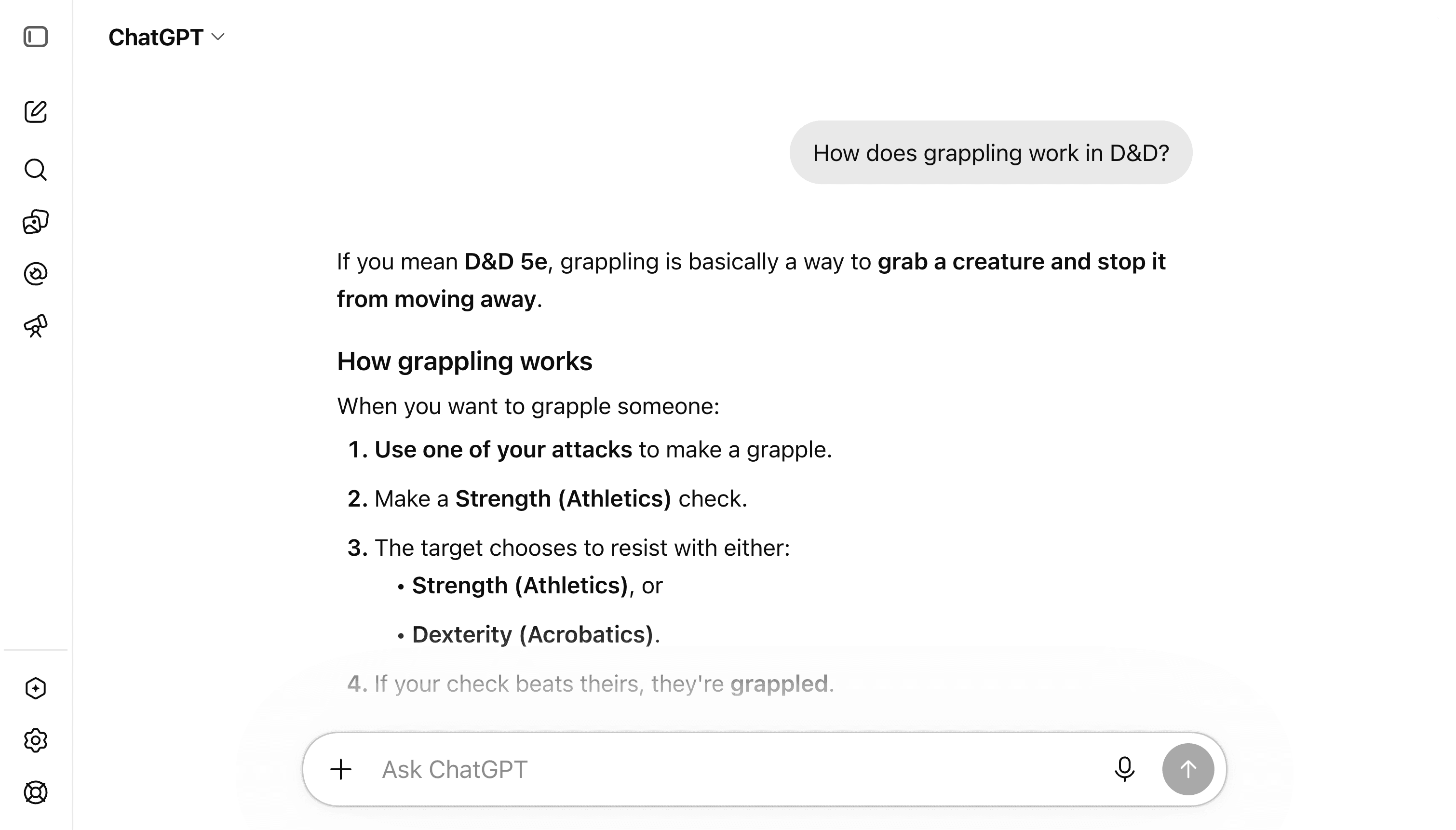
All of that D&D knowledge is mixed together in the same memory. When you ask a rules question, the AI does not automatically open the right book. It tries to guess which version you mean, remember how it works, and make something up when it cannot.
Naming your edition points that guess in the right direction, but the answer can still borrow from another edition—or hand you someone's homebrew dressed up as official rules.
So how do you prevent this?
The fix is simple: tell the AI which edition you play and ask it to check the rules online. In fact, whenever accuracy matters, ask your AI to check online instead of relying on memory. When you get tired of repeating yourself, save those directions as custom instructions or a skill.
If you have never set up custom instructions or a skill before, ask your AI to help. The steps are different in ChatGPT, Gemini, Mistral, and other apps, but your chatbot can walk you through them. Usually, all you need to say is: “Help me save the instructions below so you use them whenever I ask about D&D rules.”
# D&D rules checker

Use these instructions whenever I ask a question about D&D rules.

- My game uses D&D 5e with the 2024 rules.
- Before answering, look up the rule online for the edition I am using.
- Prefer an official rules page like https://www.dndbeyond.com/sources/dnd/br-2024. Before using a page, confirm that it matches the edition I am using.
- Base the answer on the rule you find, not on your memory of D&D.
- State which edition or rules version you used.
- Do not fill in missing details from memory. If you cannot verify the answer online, say what you could not verify.
- Clearly separate the written rule from your explanation or a suggested ruling.
- Include a link to the page you used so I can check it myself.
- If search is unavailable, say that you could not verify the rule and do not answer from memory.
Once you have saved the instructions, test them with a question where the edition matters: How does a character start and maintain a grapple? The answer should name the rules version, link to the page it checked, and admit when it cannot verify a detail.
Playing a different version? Change the first bullet to name the edition or rules version you use. Then update the “Prefer an official rules page” bullet with the rules source you want your AI to use. The rest can stay exactly the same.
Where Chucks helps
If you are playing with the 2024 D&D 5e rules, Chucks can check anything covered by the current SRD without sending your AI to search the web. Chucks includes a purpose-built rules search tool and instructions that teach your AI when and how to use it.
It’s faster, and it won’t chew through your AI subscription as quickly. By the way, Chucks is free.
Give your AI a rulebook it can actually check.
Add Chucks to a compatible AI app for free, or explore the rules guide before you decide.